The Ledger
Are rising home prices just inflation? No — and the gap is the story
Nov 26, 2026
Home prices are up and inflation happened. Are they the same thing? They are the same family, not the same thing — and right now they are moving apart, which is the interesting part.
Start with what inflation actually measures. The consumer price index tracks what it costs to live: food, energy, services, and shelter. But shelter in the index is not the price of buying a house. It is rent, plus owner's equivalent rent — what a homeowner would pay to rent their own home. The purchase price of the house itself is nowhere in the index, because a house is treated as an asset, not something you consume.
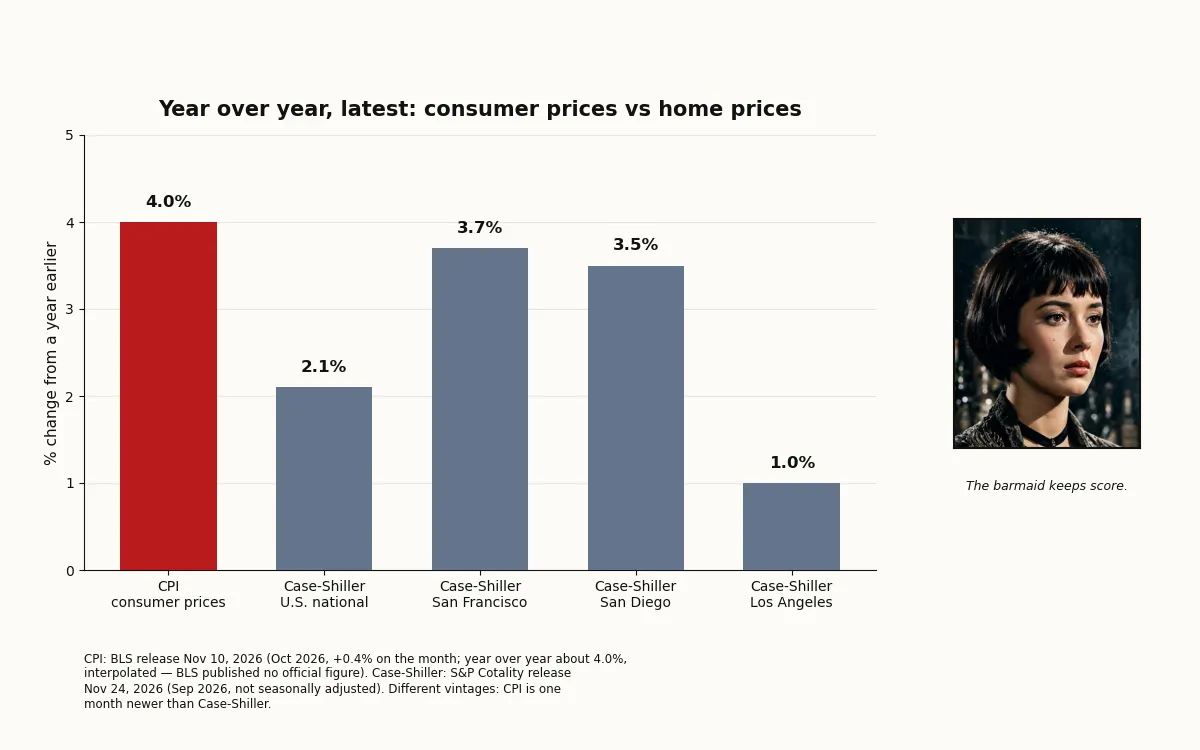
In October 2026 the consumer price index for all urban consumers rose 0.4 percent on the month, after 0.6 percent in September, according to the Bureau of Labor Statistics release of November 10, 2026. The monthly changes since April were 0.6, 0.5, minus 0.4, 0.1, 0.4, 0.6 and 0.4 percent. Shelter rose 0.3 percent in October. Year over year, the index was up about 4.0 percent — but that number is interpolated, not official: the Bureau published no official year-over-year figure because October 2025 data was not collected during the 2025 lapse in appropriations, so there is no base to compare against. Core prices, excluding food and energy, were up about 2.8 percent year over year. The index level stood at 337.511 on a 1982-84 base of 100.
Home prices are a different measurement entirely. The Case-Shiller index tracks the prices of the same single-family homes as they resell, so it measures price movement, not a shift toward bigger or pricier homes. In September 2026, the latest release (November 24, 2026), the national index was up 2.1 percent year over year. San Francisco was up 3.7 percent, San Diego 3.5 percent, Los Angeles 1.0 percent. All not seasonally adjusted.
So consumer prices, at about 4 percent, are currently rising faster than home prices nationally (2.1 percent) and in Los Angeles (1.0 percent), and roughly in line with San Francisco and San Diego. In real terms — after inflation — home prices fell roughly 2 percent nationally and about 3 percent in Los Angeles over the year. The sticker price still rose, but it bought less.
Why do they diverge? A house is two things at once: shelter and an asset. Its price is set by mortgage rates, by how many homes are for sale, by local demand, and by leverage — a buyer with a 20 percent down payment controls five times that amount of house. Consumer prices are set by the cost of producing and delivering things people use up. The two can move together for a decade and split apart for years at a time. In 2021 and 2022 home prices rose about 20 percent a year — the 20-city Case-Shiller index peaked above 21 percent year over year in April 2022 — while consumer inflation peaked at 9.1 percent in June 2022. Now the order has flipped.
There is also a welfare difference that matters. Rising home prices make existing owners wealthier — the same house is worth more. Rising consumer prices make everyone poorer — the same pay buys less. Calling them the same thing hides that one person's windfall is another person's cost of living.
Then there is the median, which is a third thing again. The California Association of Realtors reported a statewide median home price of 886,760 dollars in October 2026, down 0.1 percent year over year. San Francisco County's median was 2,390,000 dollars, up 29.2 percent; Los Angeles County 955,090 dollars, down 0.6 percent; Fresno 435,000 dollars; Kern 400,000 dollars. Only 19 percent of California households could afford the median-priced home in the third quarter of 2026.
A median is a snapshot of what sold. If more expensive homes sell in a given month, the median rises even if no individual home gained a dollar. Case-Shiller avoids that by following the same homes. That is how San Francisco's median can jump 29 percent in a year while its Case-Shiller index rose 3.7 percent: the mix of what sold changed, and the two numbers are measuring different things.
So what is worth tracking is not either number alone but the gap between them. When home prices outrun consumer prices, buying gets further out of reach — the price-to-income ratio climbs. When they lag, real prices fall even as the sticker price creeps up, which is where we are now: consumer prices up about 4 percent, national home prices up 2.1 percent, Los Angeles up 1.0 percent.
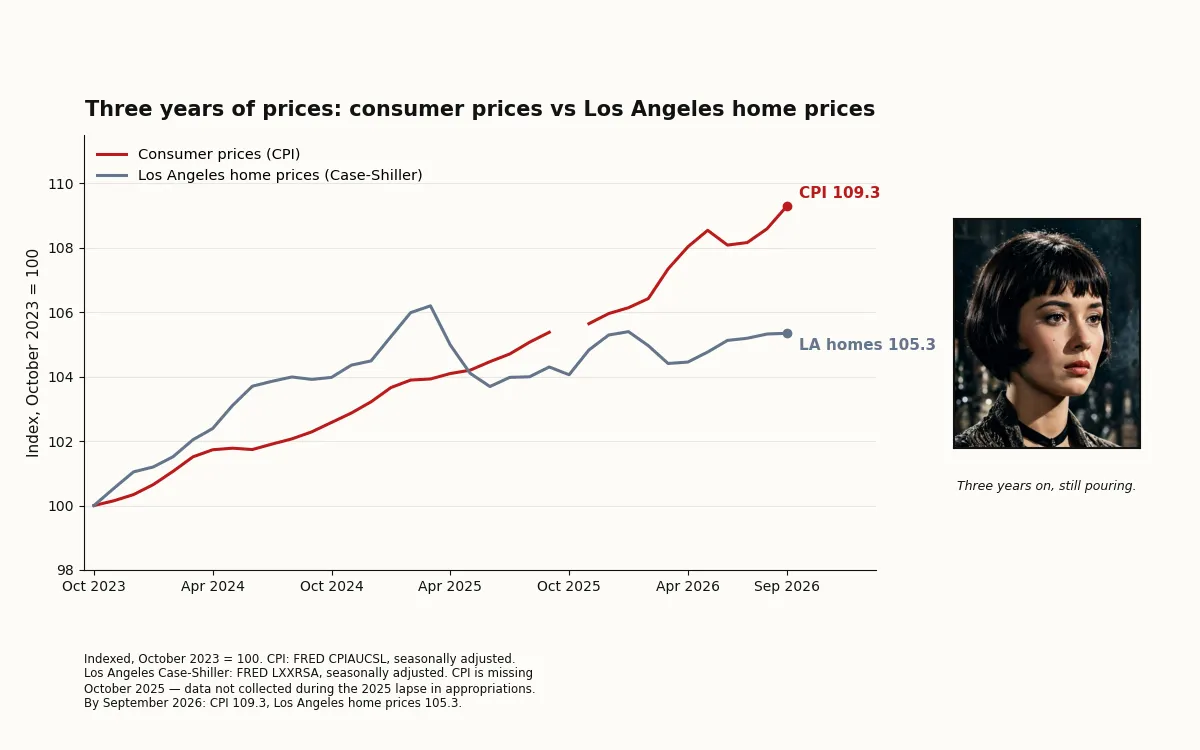
The longer view shows the same split. Set both to 100 in October 2023 and follow them to September 2026: consumer prices reached 109.3, Los Angeles home prices 105.3. Over three years, the cost of living rose 9.3 percent while Los Angeles home prices rose 5.3 percent — a four-point gap. And the level still matters as much as the rate: even with home prices trailing inflation, a median California home at 886,760 dollars is out of reach for 81 percent of households.
The question is not whether home prices are inflation. They are not. The question is what the gap between them is doing — and right now it says the cost of living is rising faster than the value of the roof over it.