Meera
Bar of Shadows: why Japanese films of the 1950s–70s sound like jazz
Nov 26, 2026
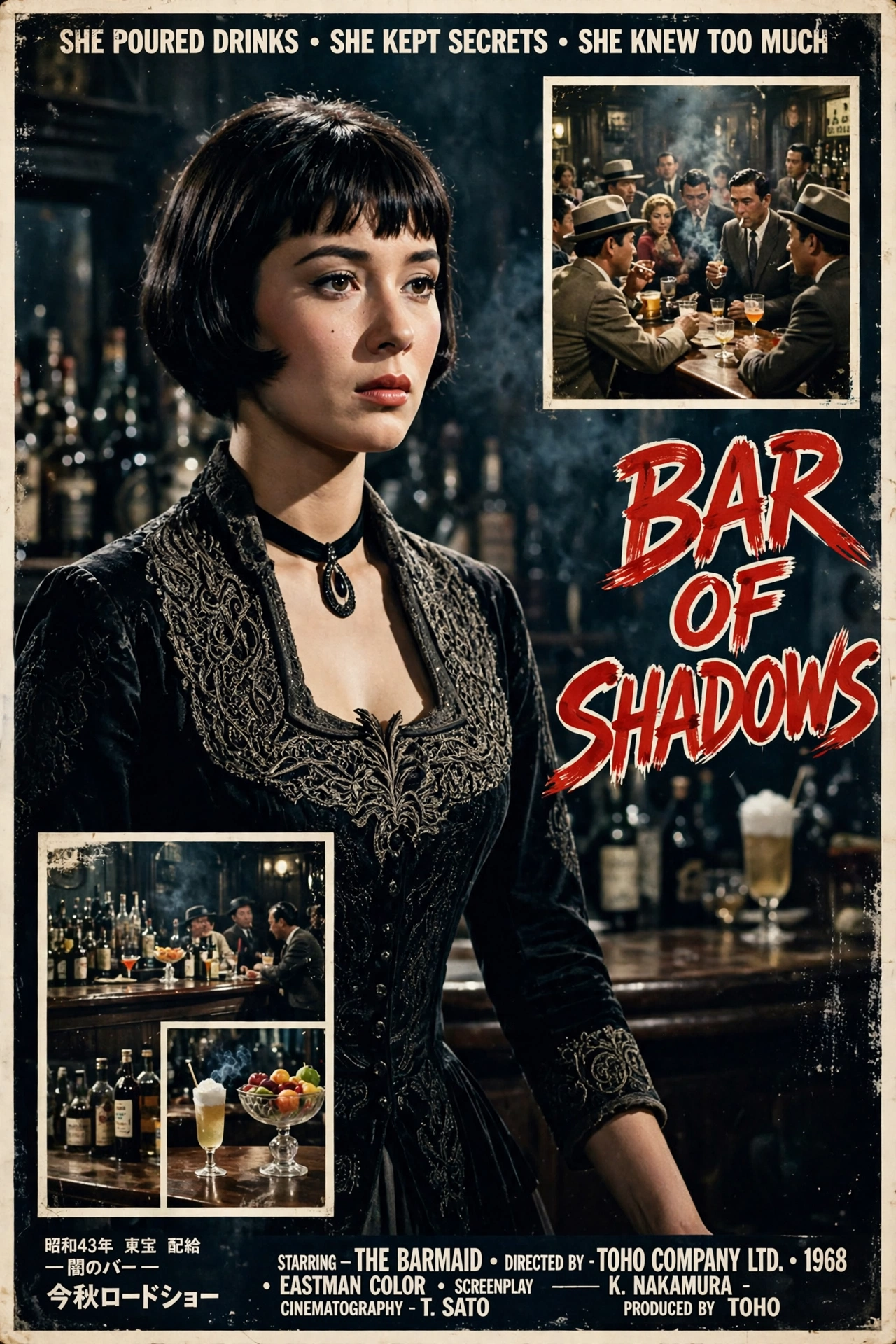
The poster is a joke that tells the truth. "Bar of Shadows" is an invented film — a 1968 Toho poster for a barmaid who never stood on a set, drawn from a pencil study of Manet's barmaid at the Folies-Bergère. But the music it promises is real. Put a barmaid, a smoky room, and a saxophone in a Japanese film from this era and you know exactly what you will hear. The question is why.
In 1950, the sound of Japanese cinema was the orchestra. Fumio Hayasaka scored Rashomon (1950) and Seven Samurai (1954) in Western symphonic language — leitmotifs, full strings, the grammar of European concert music — folded together with Japanese material. It was the sound of a cinema announcing itself to the world: Rashomon won the Golden Lion at Venice in 1951, the first Japanese film widely seen in the West, and its music sounded like it belonged on that stage. Hayasaka did the same for Mizoguchi — Ugetsu (1953), Sansho the Bailiff (1954) — and then died in 1955, at 41. His friend Akira Ifukube scored Godzilla (1954) the year before, drawing on European classical music and Ainu folk song — a brooding, percussive sound that became the monster's voice.
Then the sound changed, because the heroes changed. Masaru Sato — Hayasaka's orchestrator on Seven Samurai — took over Kurosawa's films and brought jazz with him. Yojimbo (1961) is the turning point: a mercenary samurai with no loyalties, and a main title built on a syncopated groove, tenor and baritone saxes, a tight horn section, jazz rhythms. The film's own logic demanded it. This was not the humble hero of Seven Samurai but a hired blade, and the music had to sound modern, American, and slightly dangerous. Sato scored Sanjuro (1962) and Throne of Blood (1957) the same way; his first feature score had been Godzilla Raids Again (1955).
Toru Takemitsu, the other Hayasaka protege, went further. His first feature score, Crazed Fruit (1956), was jazzy — saxophones, muted trumpets, sliding electric guitars, made with Sato. But Takemitsu's real signature was the opposite of jazz: silence, and the space between sounds. In Woman in the Dunes (1964) his score is dissonant and sparse, and across more than 90 films he mixed Japanese instruments with Western orchestras and long stretches of near-silence. By the mid-1960s, jazz and silence were the twin signatures of the Japanese New Wave.
Why jazz? Because jazz was what the bar sounded like. Postwar Japan's bars, clubs, and late-night streets ran on American music, and the films set there — the noir corners of Tokyo, the drifters and hustlers — needed music that said this is the new Japan, and it is not safe. Jazz did that work in a single saxophone phrase: modernity, the night, the outsider. It also said something about who these films were for — a young, urban audience that had grown up with the occupation's radio and wanted its own movies to sound like its own nights.
So the poster's tagline is the review: she poured drinks, she kept secrets, she knew too much — and behind her, the band is playing jazz. The barmaid never existed, but the sound did. If you want to hear it, start here:
Yojimbo (1961), Masaru Sato — the main title. The moment film music in Japan turns modern.
Crazed Fruit (1956), Toru Takemitsu with Masaru Sato — the first jazzy Takemitsu score, saxophones and muted trumpets.
Seven Samurai (1954), Fumio Hayasaka — the orchestral sound it all broke away from.
Godzilla (1954), Akira Ifukube — the brooding opposite: folk-rooted, percussive, the monster's voice.
Woman in the Dunes (1964), Toru Takemitsu — the other direction: dissonance, space, and silence.